Wednesday, May 4, 2022

Swynwraigs of Cerdiwen, Part III

What unfolds might not always be so easily met.

Divine Tests
1-4. How do you show your awen? The swynwraig will be preoccupied for the next 2d6 turns unless she does something based on which of her aspects applies at the time. If she does so, then she need only be so occupied for 1d6 turns.
Ceridwen the Transforming: work to alter something.
Ceridwen the Mother: care for her offspring.
Ceridwen the Wise: dispense wisdom.

5-9. The shifts become more plain to see. The swynwraig loses access to some of her spells (50% chance for each one), possibly including her turn ability. Either roll 1d4 or select to see what she needs to do to get each one back based on which aspect of Ceridwen fits best. Each requires roughly 1d6 turns once a fitting subject has been found and a successful Wisdom check with a -5 penalty (DC 20) made.
[1] Make someone more beautiful, brighter. (the Transforming or the Mother)
[2] Make someone wiser, more deep. (the Mother or the Wise)
[3] Chase after someone, consuming aspects of them for rebirth, whether symbolically or not. (the Mother or the Transforming)
[4] Recite a poem, inspiring someone. (the Transforming or the Wise)

10-16. Insightful, maternalistic remoldings befall the swynwraig. Whether rolling 1d6 to randomly determine what it is or selecting based on her resonance with the aspect, the test will cause her to be changed for a duration of one year and a day.
[1] Every 1d12 days, she is turned into either a greyhound, otter, or hawk for the next 4d6 hours. And though she assumes that animal's mind during that time, she does gain a +5 bonus to dealing with animals of that type afterwards until her next change. (the Transforming)
[2] If she falls in battle or gives birth, any of her allies within 1d10 x 20 feet gain a +1d3 bonus to all rolls for the next 1d6 hours. 
(the Transforming)
[3] Like Morfran, she becomes dark, dumb, and deformed, losing 1d2 Intelligence and Charisma. (the Mother)
[4] Like Creirwy and Taliesin, she becomes light, bright, and beautiful, gaining 1d2 Intelligence and Charisma. (the Mother)
[5] Whenever she's asked a question, her reply is difficult to fathom, requiring a Wisdom check (DC 15) to comprehend. (the Wise)
[6] Whenever she's asked a question, there's a 10% chance of her being able to immediately cast a divination spell that she knows, and it doesn't count against her daily spell limit. Still, only those who don't know that the swynwraig has this trait will be able to trigger it. (the Wise

17+ Who's tending the cauldron? The swynwraig must undergo an ordeal to find out for 1 day, plus 1 additional day per divine test result over 17. Roll 1d2 or select which occurs based on the most fitting aspect. Once selected, every day that the test is in effect requires new rolls within one of the following situations.
[1] She becomes a greyhound, otter, or hawk while the last person she spoke to becomes a hare, fish, or bird respectively. A chase ensues and there's a base 10% chance of the hunted becoming eaten each day. If this occurs, then the victim must save vs. death/ make a Will save DC 10. Success indicates that the victim simply awakens unharmed the next day. Failure shows that the victim is now inside the swynwraig, waiting to be reborn/ reincarnated sometime within the next 1d8+1 months. Friends and allies of the one consumed will likely take a dim view of the swynwraig- a base 95% chance. (the Transforming or the Mother)
[2] She must supervise a cauldron. Each day, there's a base 25% chance of the swynwraig getting burned by a drop, tasting it, and then she must save vs. poison/ make a Fortitude save DC 15. Failure indicates that the swynwraig is chased and consumed by an avatar of Ceridwen, reborn 1d10 months later. Success indicates that she gains beauty and insight- a +2 to Charisma and Wisdom. (the Wise: or the Transforming)

For random Ceridwen encounters, see here.


Next week, Swynwraigs of Ceridwen, Part IV!


Wednesday, April 27, 2022

Swynwraigs of Ceridwen, Part II

Ceridwen's Magical Side-Effects
Those who call upon Ceridwen's magic may access it with her as Mother, Transforming, Wise, or all three. Roll 1d12 and consult the following table. If a requirement is then called for, roll based on one of her aspects below.

1. Gofyniad: Something is needed for the spell to work. Once given, it will.

2-3. Cymwynasgar: If something isn't provided, then the magic will only occur at 50% its usual strength. 

4. Yn Araf: The spell will happen, but if the swynwraig doesn't perform a requirement, its effects will only transpire 2d3 turns later.

5. Teyrnas Ceridwen: All within 1d6 x 10' gain a +1d3 bonus to certain rolls for the next 2d6 rounds, depending on which one of Ceridwen's aspects is manifest: mothering, transforming, or being wise. 

6-8. Awen Arwydd: Except for a possible, minor occurrence representing wisdom, mothering, or change (a 50% chance), the spell works as usual this time. 

9. Mad: The spell needs a requirement and will also have a 50% bonus to its effect, range, or duration. If not given, nothing will occur.


10. GwellThe magic's effect, range, or duration can be boosted by 50% by adding a requirement. If that doesn't happen, then it simply works normally. In addition, if the swynwraig does adds a requirement, then she can gain a +2d3 for the next 1d6 rounds to certain rolls based on which aspect of Ceridwen most resonates with her: mother, transforming, or wise.

11-12. CrochanThe spell occurs for an additional 50% bonus (or 100% if a 12 was rolled) to its usual effect, range, or duration, as well as it not being expended that day. What is more, if the swynwraig has a cauldron prepared and nearby, then one of those spell elements may be tripled.

Requirements by Aspect
Roll either based on which facet of Ceridwen the caster most resonates with or simply pick one at random.

Ceridwen the Transforming (d4)
The spell must involve...
1. Greyhound & Hare: moving quickly, the chase, or fleeing.
2. Otter & Fish: desire or going below.
3. Hawk & Bird: transcendence or victory.
4. Birth & Grain: transmutation or mercy.

Ceridwen the Mother (d4)
The caster must be located near or in view of...
1. Tegid Foel: a husband, a lake, or a large man.
2. Morfran Afaggdu: a son, ugliness, or darkness.
3. Creirwy: a daughter, beauty, or the moon.
4. Taliesin: a son, handsomeness, or the sun.

Ceridwen the Wise (d4)
The caster must...
1. Drink a potion or give the spell's recipient a potion to drink.
2. Be bent or crooked.
3. Wear white or be elderly.
4. Say a poem or sing a song.

For example, a swynwraig of Ceridwen casts a spell and her player rolls a 4 (Yn Araf). Thus, if she doesn't perform a requirement, the spell's effects occur 2d3 turns later. With time being of the essence, her player rolls for a requirement. Resonating most with Ceridwen the Mother, she rolls on that table and gets a 3 (Creirwy). Therefore the swynwraig must be near or see a daughter, beauty, or the moon in order for that requirement to be met.

For the full article, including magical side-effects by cleric type, see here.
--------------------------------------------

Next week: Swynwraigs of Ceridwen, Part III!


Wednesday, April 20, 2022

Swynwraigs of Ceridwen, Part I

Ceridwen
Welsh Goddess of Wisdom, Transformation, & Rebirth

Tenets of Ceridwen
* Espouse wisdom & inspiration
* Guard your children
* Change as needed...

* ...to be reborn again

Swynwraigs of Ceridwen
Special: Ceridwen is served by swynwraigs (Welsh sorceresses), druidesses, gweledydds (Welsh seers), & gwiddons (Welsh witches). In addition, she can be followed in one of a number of ways, granting different abilities based on  her various aspects (see below). Which one applies to a follower can either be selected and remain set, can be determined at random as the situation warrants, or can even change over time. 
Allowed Weapons: Staff, dagger, club
Allowed Armor: None
Symbols: Cauldron, Branch, White 
Can Turn(by aspect)
   Ceridwen the Transforming: any who resist change (if not known, 75% chance if Lawful, 50% chance if Neutral, 25% chance if Chaotic).
   Ceridwen the Mother: any who might endanger the swynwraig's children.
   Ceridwen the Wise: the unwise (if not known, 
any with a Wisdom score below a certain number- roll 3d6 to determine what it is each time turning is attempted).

Mysteries of Ceridwen: Up to once per day per level, spellcasters who follow Ceridwen can reroll one of their saves or spell rolls when:
   Ceridwen the Transforming: experiencing transformation.
   
Ceridwen the Mother: protecting their children.
   Ceridwen the Wisedealing with wisdom.

For example, a swynwraig of Ceridwen might turn as Cerdiwen the Mother, then access mysteries as Ceridwen the Transforming in a particular instance, or all the time, or turn and access mysteries as Ceridwen the Mother only, etc.

For details on  related divinities, read here.
-------------------------------------------------------------------


Next week: Swynwraigs of Ceridwen, Part II!


Wednesday, April 13, 2022

Goblins, Part III

Goblin Divinities & Cults
Nearly as multitudinous as the evil creatures themselves are the beings that they make obeisance to.

What Goblins Worship (d4)
   1. Tezschnaz (see Volume I)
   2. a random arch-devil or evil god (e.g. Geedeepee- link)
   3. a random demon lord (e.g. Tiamat- see Volume III)
   4. a specifically goblin divinity (see below)

   
Random Goblin Divinity Generator
Roll 1d2 times on the following table. Each result indicates part of the goblinoid deity, arch-devil, or demon lord's name translated into the human tongue, along with which special abilities its followers typically have (defined in Part I).

1d12
1. Boom (Certain Colored Goblin)
2. Many (Goblin Horde)
3. Great (Goblin King*)
4. Spirit (Goblin Shaman*)
5. Sneak (Goblin Thief)
6. Might (Goblin Warrior)
7. Slay (Hobgoblin Guard)
8. Stern (
Hobgoblin Militant)
9. Master (
Hobgoblin Monk)
10. Blood (Hobgoblin Priest*)
11. Dirty (Mischievous Hobgoblin)
12. Scary (
Scary Hobgoblin)

Then roll to see what the name ends with (1d3).
1. 'God': obeyed by goblins in a way reflecting some religious zeal, but is ultimately underhanded.
2. 'Demon': goblins follow it with open depravity.
3. 'Goblin': seen as a great ancestor that has achieved godhood, arch-devilry, or demonhood.

For example, Scary Slay Demon (rolling a 12 & 7 on the first table, 2 on the second) would have many scary hobgoblins and hobgoblin guard followers, replete with much terrorizing and chanting.

On the hand, Dancer Goblin (13, and then 3) or Sneak Many God (rolling 5, 2, and then 1) would have goblins who dance, and goblin thieves and goblin hordes instead.

*Note3% of goblins encountered will have one of the leader-type abilities of Goblin King, Goblin Shaman, Hobgoblin Priest, or the like in addition to the typical ones for which their goblin divinity is known. If one or more of those abilities is the goblin divinity's actual focus though, then only 10% of its followers will have them- any remaining goblins are just more terrified of their power (and thus have less goblinoid urgings to be underhanded to them). 

For example, a group of 30 hobgoblin followers of  Stern Devil will usually have either a king or spellcaster as a leader, in addition to the rest being hobgoblin militants. A group of 60 might have two with the leader-type abilities. On the other hand, goblins who follow a 'Great', 'Spirit', 'Blood', or 'Spooky' goblin divinity might have 3 goblins or hobgoblins with such abilities for every 30 of their number. The rest likely won't have any special abilities except for being useful fodder.

Read the full article with additional options here.

Next week: we begin a new series on Welsh divinities!


Wednesday, April 6, 2022

Goblins, Part II

Goblin Magical Side-Effects
Wicked creatures work in cruel ways, though in the case of goblins, such malevolence doesn't always come out the way they intend it to. 

Roll 1d12 when one casts a spell and consult the table below for the general side-effect. If it then calls for a requirement, roll on the table for the goblin's spellcaster type to determine what it is. 

1-2. Beware - My - Magic! The goblin's spell does absolutely nothing, though the goblin has a 50% chance of believing it works anyway. In that case, it will act accordingly.

3-5. More? The goblin needs to follow a requirement for the spell to happen.

6. More! There are always too many goblins. To punctuate this fact, any (including the spellcaster) within a 1d6 x 5' appear to be doubled in number, though these are simply mirror images that last up to 3d6 rounds and vanish when hit. In addition, for every 1d4 rounds of the duration, the goblin must follow a requirement too in order to make the effect continue.

7-10. No Side-Effect: Apart from the goblin acting as strangely as it usually does, nothing additional occurs or is required with the spell this time.

11-12. Goblin Blood MagicThe goblin can now increase the spell's range, effect, or duration by 50% if it has inflicted some harm within the last 24 hours (if not known, there's a base 50% chance of that being so). What is more, if the goblin chooses to follow a random requirement from its spellcaster list, then the target of its spell must also save vs. death/ make a Will save DC 10 or take 1d8 damage.


Requirements by Goblin Spellcaster Type
Different varieties of goblin spellcasters have different malefic requirements for making their spells work. When one is called for, roll on the corresponding table below. Note that if the spell's effects would fulfill the requirement if the magical side-effect was applied, then the requirement in that case can be considered met.

Goblin Shaman 
Per Tezschnaz, or roll 1d8.
1. Act like a random animal for 1d3 rounds.
2. Speak to things that aren't there for 1d3 rounds.
3. Hallucinate for 1d4 rounds.
4. Scream at the top of their lungs for 1d4 rounds.
5. Drum loudly and/or dance crazily for the next 3d6 rounds.
6. Kill in a particularly spectacular way.

Hobgoblin Priest
Being more intelligent, hobgoblin priests add 1 when rolling on the Goblin Magical Side-Effects table, but their own requirements can be quite demanding, requiring either an Intelligence, Wisdom, or Charisma check (DC 15) to be successful (generally a 75% chance). Roll 1d6.
1. Properly bow to their master.
2. Recite hobgoblin liturgy without error.
3. Discipline a subordinate severely.
4. Draw blood from a victim with great prejudice.
5. Masterfully abuse a slave or sacrificial victim, or capture one to be either.
6. Kill in a particularly gruesome way.

For example, a goblin shaman casts a spell and the Referee rolls 11 on the d12 (Goblin Blood Magic). He then rolls a 3 on the Goblin Shaman table, so if the goblin has inflicted some harm within the last 24 hours, one of the spell's aspects can be increased by 50%. And if the goblin hallucinates for 1d4 rounds too, then its target will take 1d8 extra damage. Note that if the Referee had rolled a 6 for the requirement, then that will be met if the spell would end up killing the target.
 
Read the full article with details on goblin cultists here.


Next week: Goblins, Part III!


Tuesday, March 29, 2022

Goblins, Part I

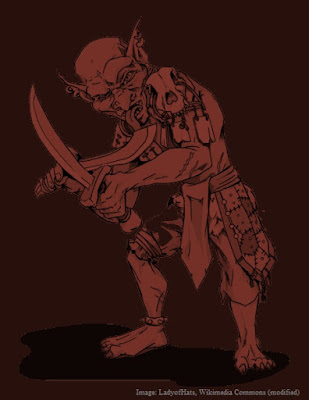
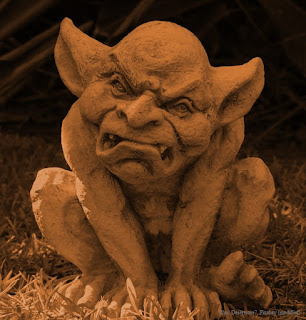
Goblins 
Stats: Goblins have the following modifiers.
  * +1d4 Dexterity, along with -2d3 Strength, Intelligence, Wisdom, Constitution, & Charisma.
  * +2d3 bonus to checks made to deceive and backstab others, being naturally treacherous.
  * Typically underhanded as well, they must save vs. spell/ make a Will save DC 15 to refrain from torturing defenseless prey or even betraying allies if they can get away with it.
  *Base 75% chance of being subterranean/ nocturnal, suffering a -1d6 rolls when in bright light, but can also see in the dark.

Goblinoid Divinities & CultsTezshnaz, arch-devils, and other demon lords
HD: d4
To-Hit Bonus: +1 per 3 HD, rounded up (+1, +1, +1, +2, +2, +2, etc.)
Saving Throws
All: +1 bonus per 3 HD.
Usual Weapons: Goblins & Wild Goblins- club, bow, spear, sling, dagger
Hobgoblins- mace, crossbow, polearm, sword
Usual Armor: Goblins- leather or lighter, Hobgoblins- splint or lighter, Wild Goblins- none!

Special Abilities: Goblins usually have 1 special ability per odd HD (1, 3, 5, etc.) Each one also has a compulsion too- an associated despicable manner to match. Such despicableness can be resisted by saving vs. spell/ making a Will save DC 15 on an individual basis. This malevolent nature is in addition to their propensity for underhandedness (detailed above).

Though each ability is listed under a particular goblin  type, they can be selected from different types with the Referee's permission, enabling the creation of other types of goblins (e.g. gremlins, unseelie goblins, tunnel goblins, kobolds, etc..) Each ability can also be selected more than once, allowing the bonuses to compound each other. 

Common Goblins
[Certain Colored] Goblin: gain a +1d2 to all rolls in certain situations depending on their hide color, but also suffer the same in penalty when they don't occur. Green Goblins: when doing something envious. Bright Yellow Goblins: when enforcing conformity. Burnt Orange Goblins: when gathering victims for sacrifice and/or torture.
Goblin Horde: unfailingly have 2d4 extra goblins in the area. T
here are always one goblin too many, but this special ability makes that worse: more keep popping up even if slain, until the actual goblin who has it is slain. 
Goblin King: gain +1d8 HD and can compel other goblins to follow its commands. It has a base chance of being successful depending on goblin type: common goblins- 75%, hobgoblins- 50%, wild goblins- 25%, but for those non-goblins who disbelieve his power (by making a save vs. death/ Will save DC 10), he will then have no power over them.
Goblin Shaman: gain the spellcasting abilities of a 1st level cleric, but also roll for goblin magical side-effects (see Part II), and will refuse to use armor or other sensible protection.
Goblin Rogue
can escape capture once per day, but must otherwise always engage in overly complicated plans.
Goblin Warriorgain an additional +1 bonus to hit and to AC. Must flee from any for that's seemingly stronger than them though, even if inopportune.

Hobgoblins
Unlike goblins, they suffer no Strength, Intelligence, Wisdom, or Constitution penalty. Their Charisma penalty is also only -1d3+1.
Hobgoblin Guardgain an additional +1 bonus to hit, damage, and to AC, but must chant loud songs whenever marching.
Hobgoblin Militant: gain a +2 bonus to initiative and a +1 bonus to hit non-Lawful types, but must always obey their commanders and keep their weapons polished.
Hobgoblin Monk: can make 2 unarmed attacks each round for 1d2 + Strength modifier damage, but insist on strict discipline  at all times (which is antithetical to most goblins).
Hobgoblin Priest
gain the spellcasting abilities of a 1st level cleric, but also roll for goblin magical side-effects (see Part II) and must always work to take prisoners for slavery and/or sacrifice.
Mischievous Hobgoblin: gain the skills of a 1st level thief, but must engage in pranks whenever possible.
Scary Hobgoblincan scare others who first see them, causing a -1d3 to all rolls for the next 3d5 rounds (save vs. death/ make a Will save DC 10 negates), but the goblin will attempt to frighten anyone it first encounters, including potential allies.

See bonus content, including another type of goblin, here


Next week: Goblins, Part II!


Wednesday, March 23, 2022

Orcs, Part III

Orcish Divinities & Cults

Where Orcs Came From
Whatever foul entities gave birth to such a depraved folk isn't entirely known. The most common theories include (select or roll 1d4):
1. Warped and corrupted elves, done by one or more demon lords.
2. Lemurian-type hideous merging of fell men and beast.
3. Experimentations, likely by some mad wizard, made to be his merciless, splenetic, loyal foot troops (though they ended up betraying him anyway).
4.  A naturally occurring race, nevertheless still naturally brutal and evil.

Orc philosophers are surprisingly unclear on the matter.

In any case, orcs follow abominable entities, whether Orcus, the quintessential orc divinity (likely after whom the race was named), other demon lords, arch-devils, evil gods, other orc divinities of their own, or even corruptions of the wholesome gods that humans might follow. The latter is especially understandable since orcs cannot really create, they can only pervert.

What Orcs Worship (d6)
   
1. Orcus (see Volume II)
   2. a random arch-devil or evil god (e.g. Nergal- see Volume III)
   3. a random demon lord (e.g. Chernobog - see upcoming Volume IV)
   4-6. another specifically orc divinity (deity or demon lord- see below)
   
Random Orc Divinity Generator
Roll 1d2 times on the following table. Each one indicates part of the orc deity or demon lord's name translated in the human tongue, along with which special abilities its followers typically have* (defined in Part I).

1d12
1. King (Orc Chieftain)*
2. Axe (Orc Warrior)
3. Magic (Magic Orc)*
4. Hand (Orc Degenerate)
5. Fire (Orc Pillager)
6. Fist (Orcish Pugilist)
7. Black (Orc Militant)
8. Eye (Orc Warlord)
9. Evil (Orc Witchdoctor)*
10. Master (Golden Orc)
11. Blood (Orcish Manslayer)
12. Wild (Orc Savage)

Then roll to see what the name ends with (1d3).
1. 'God': obeyed by orcs in a way reflecting some religious zeal, but is ultimately depraved.
2. 'Demon': orcs follow it with open depravity.
3. 'Orc': seen as a great ancestor that has achieved godhood or demonhood.

For example, Magic Master Orc (rolling a 3 & 10 on the first table, 3 on the second) might be some sort of upstart, he is softer and more versatile than Orcus, seeking human worship. Black Hand God (rolling 7 & 4, then 1) might be followed by both orc militants and degenerates, precariously bound together by some minor dogma.

*Note3% of orcs will have one of the elite abilities of Orc Chieftain, Magic Orc, or Orc Witchdoctor in addition to the typical ones for which their orc divinity is known. If one or more of those abilities is the orc divinity's actual focus though, then only 10% of its followers will have them- any remaining orcs are just more cowed by their power (and thus have less orcish urgings to kill such leaders). 

For example, a group of 30 orc followers of  Blood Demon (orcish manslayers) will usually have either a chieftain or spellcaster as a leader. A group of 60 might have two, etc. On the other hand, orcs who follow a 'King', 'Magic', or 'Evil' orc divinity might have 3 orcs with such abilities for every 30 of their number. The rest likely won't have any special abilities, except for being fodder.

Read the full article with additional options here.


Next week: our series on folk concludes for a time with goblins!


Wednesday, March 16, 2022

Orcs, Part II

Orcish Magical Side-Effects
Debased in mundane affairs, it is no surprise that orcs are degenerate in magical matters too, for their evil can only ruin what good folk may have made. When one casts a spell, first roll 1d12 on the table below for the general side-effect. If a requirement is called for, then roll on the table for the orc's spellcaster type to determine what it is. 

1-2. Urge-Driven: The orc gives into one of its urges, whether general orc belligerency or from another it has, being unable to resist doing whatever particular evil is in its nature for the next 1d3 rounds. And not only does the spell not work, it has a 50% chance of being lost too.

3-5. Demands of Aggression: The orc must follow a requirement for the spell to function.

6-7. Orc FoulnessAll within 1d10 x 5' becomes seemingly derelict and dark for the next 1d20 rounds, causing any non-orcs who are there to save vs. death/ make a Will save DC 10 or suffer a -1d4 penalty to all rolls. In addition, the orc must follow a requirement every 1d4 rounds in order to maintain the area, up until the time it would expire.

8-11. No Side-Effect: Nothing additional occurs or is required this time.

12. Orcish Black Magic: If the orc has abused another sometime within the last 24 hours (if not known, there's a base 75% chance of that being so), it can then double the spell's range, effect, or duration. In addition, if the orc chooses to follow a random requirement from its spellcaster list, its target must also save vs. death/ make a Will save DC 10 or become possessed by a fell orcish spirit, being forced to give into a random orcish urge for the next 3d4 rounds. 


Requirements by Orc Spellcaster Type
Different types of orc spellcasters have different abominable requirements for making their fell spells work. When one is called for, roll on the corresponding table below.

Magic Orc (d8)
1. Wallow in filth, whether physical or metaphorical.
2. Speak in a weird voice for the next 1d6 turns.
3. Defile something pure.
4. Imbibe an intoxicant, taking a -2d6 penalty to all rolls for the next 1d6 turns.
5. Drum loudly and dance crazily for the next 3d6 rounds, taking a -1d3 penalty to unrelated rolls.
6. Attack an innocent, or at least one who is weaker than the orc.
7. Kill an innocent, or at least one who is weaker than the orc.
8. Per Orc Witchdoctor, below.

Orc Witchdoctor
Per Orcus (see Volume II) or roll d8:
1. Be possessed by a fell orcish spirit, and must act especially wild and aggressively for the next 1d6 turns.
2. Hold an effigy doll of the spell's target. If one isn't ready, it takes 1d3 rounds to make.
3. Recite a strange rhyme. Those who hear it must save vs. death/ make a Will save DC 10 or have it stuck in their head for 1d3 days.
4. Use an exotic or rare (and likely gruesome and unpleasant) spell component.
5. Brandish weapons and act very aggressively.
6. Slap or otherwise accost the spell's target.
7. Kill the spell's target
8. Per Magic Orc, above.


For example, a magic orc casts a spell. The Referee rolls 3 on the d12 (Demands of Aggression) for it. He then rolls a 7 on the Magic Orc table, so the orc must k
ill an innocent, or at least one who is weaker than it, in order for the spell to work. 


For information on Orcish Occultists, read the full article here.


Next week: Orcs, Part III!


Wednesday, March 9, 2022

Orcs, Part I

Orcs
Stats: Orcs have the following modifiers.
     * +1d4 Strength & +1d2 Dexterity, along with -2d4 Intelligence, Wisdom, & Charisma.
     * +2d4 bonus to checks made to intimidate others and +1d4 to initiate attacks, being inherently belligerent.
      * Natural bullies as well, they must save vs. spell/ make a Will save DC 15 to refrain from being hostile to and/or taking advantage of those who they see as weaker than them.
     * Base 33% chance of being subterranean/ nocturnal, suffering a -1d4 rolls when in bright light, but can also see in the dark.

Orcish Divinities & Cults
Orcus, Magic Master Orc, fell imposters, Ape God, Pig Demon, other demon lords, evil gods.

HD: d6+2
Attack Bonus: +1 per 2 HD, rounded up (+1, +1, +2, +2, +3, etc.)
Saving Throws
Reflex- and Fortitude-based:+1 bonus per 2 HD.
Will-based: +1 per 4 HD.
Usual Weapons: axe, scimitar, spear, dagger
Usual Armor: chainmail or lighter
Special Abilities: Orcs have uniquely fell abilities, typically 1 per odd HD (1 for 1 HD, 2 for 3 HD, etc.) Each one  also has a matching compulsion too- an orcish urging, reflecting its depravity. Such urgings can be resisted by saving vs. spell/ making a Will save DC 15 on an individual basis, though most orcs lack the will to successfully do so, let alone the compunction. These urgings come in addition to the general orcish predilection to hostility, which remains primary if an orc ends up being torn between the two.

Though listed under particular orc types, orcish special abilities can be selected from different ones with the Referee's permission, especially if wishing to create other types of orcs (e.g. cave orcs, demonic orcs, etc.) Each ability can also be selected more than once, allowing the bonuses to compound each other. For example, selecting Magic Orc twice would allow the orc to cast spells as a 2nd level magic-user. 

Common Orcs
Orc Chieftain: gain a +1d4 bonus to hit, +1d4 HD, and a +1d4 bonus to saves. but must always maintain a harem, even if inopportune. Must also watch out for potential usurpers, who must save or attack him if he appears weak.
Orc Warriorgain an additional +1 bonus to attack, +1 to damage, and +3 hit points. Must attack anyone seemingly weaker than them though.
Magic Orc: gain the spellcasting abilities of a 1st level magic-user, but also roll for orcish magical side-effects (see Part II), and must work to set themselves above all others.
Orc Degenerate: gain a +4 bonus to manipulate and deceive others, but will destroy their own lairs and lands when frustrated.

Black Orcs
Orc Militant: can automatically ignore up to 3 of their other orcish urgings each day, but must attack any other orcs who do give into them.
Orc Warlord: can add 1 to their bonus either to hit, damage, or AC each round for every odd HD they have (+1 if 1 HD, +2 if 3 HD, etc.) when armored and fighting alongside other orcs, but must kill any orcs who fail to obey them.
Orc Witchdoctor: gain the spellcasting abilities of a 1st level cleric, but also roll for orcish magical side-effects (see Part II), being often possessed by fell spirits.
Golden Orc: can manipulate humans, causing them to save vs. spell/ make a Will save DC 15 or believe the orc is worthy of respect and admiration. Those under its spell must also save when encountering other orcs (even if they don't have this special ability). Non-golden orcs typically despise such orcs and will slay them when discovered unless they have good reason not to.

Primitive Orcs
Orc Savage: can do +1d2 damage per hit in melee and can immediately attack a foe once again after hitting them, but must keep attacking for at least 6d6 rounds, even going after allies if no others remain to try to kill during that time.
Ape Orcgain +2d4 to climbing checks, +1d2 x 5' climbing speed, a +1d2 AC bonus to dodge attacks, and can make two slam attacks each round for 1d3 + Strength modifier damage. Must otherwise act apishly, will not wear armor, and must flee from fire and other pyrotechnics.
Big Orc: gain 1d3 Strength and Constitution, 1d10' in height, and 1/2 the height increase in HD, rounded up (1-2': +1 HD, 3-4': +2 HD, etc.), but also lose 1d4 Dexterity and 2d6 Intelligence.
Pig Orcgain +1d3 x 5' charging speed, a +1d3 AC bonus vs. bludgeoning attacks, +2d3 hit points, and can make an extra attack against any foes that they knock down. Lose 1d3 Charisma and Dexterity though, and must act piggishly, and take and hoard any food, valuables, and comforts that they can get their hands on.

Read the full article here.


Next week: Orcs, Part II!