Wednesday, February 16, 2022

Dwarves, Part II

Additional Dwarf Abilities
For those who want more than just the talents of a hill dwarf, see the following. And though each one's corresponding tendency can be resisted by saving vs. spell/ making a Will save DC 15 on a case-by-case basis, few dwarves would want to. For example, a dwarf berserker might choose to save to try to stop fighting a battle that was impossible to win or to even wear armor, but not if his personal honor was at stake.

Mountain Dwarves
Dwarf Berserker: gain a +2 to hit and to damage in melee, along with being able to attack an extra time each round, but must never break off from a fight, nor wear armor.
Dwarf Runemaster: gain the magical abilities of a 1st level cleric, but must carve runes in order to cast spells. Up to their level x 2 can be in existence at one time, and they can then even be activated by others who touch them. Dwarven runecasters  will also only give their runes to other dwarves and roll on the dwarven magical side-effects table (see Part III).
Dwarf Strengthgain an extra 1d2 Strength, but will never allow themselves to be one-upped.
Dwarf Toughness
: gain an extra 1d2 Constitution, but must act harshly, being unable to accept compassion.

Black Dwarves
Dark Dwarf: gain the magical abilities of a 1st level cleric, but must invert the truth, sometimes even speaking backwards. When casting spells, they may choose to roll for dwarven magical side-effects (see Part III) or for the arch-devil or dark deity they follow.
Exploiter: gain a +5 bonus to manipulate and take advantage of others, but must do so whenever possible, even when inopportune. Fittingly, when they fail a roll, 
their great sense of concealed inferiority comes through and they suffer a -5 to all rolls for the next 1d6 turns.
Fell Shapeshifter: can turn into a monster with a HD equal to their dwarf level/HD x 2, but will become consumed with greed, attacking any who might threaten their treasure.
Goblin-blooded
: become trusted amongst such kind, gaining a +5 bonus to influence them. Also gain a strange, dusky complexion and features akin to goblins though, making other dwarves have to save or attack them on sight.

Gnomes
Treat as dwarves, except that they have a -2d3 penalty to their Strength, -1d3 penalty to their Constitution, and are 1d4 feet shorter. In return, their personalities are more passive and flexible.
Forest Gnome: gain a +2 to all rolls when in forests, but must respect them and their denizens.
Garden Gnome: gain a +2 all rolls when in gardens or other scenic areas, but must wear pointed and/or bright hats.
Just a Gnome: those wishing to harm them must save vs. death/ make a Will save DC 10 or otherwise feel too much sympathy to do so. In return, such gnomes can't initiate violence.

Read the full article here.


Next week: Dwarves, Part III!
Monday, February 7, 2022

Dwarves, Part I

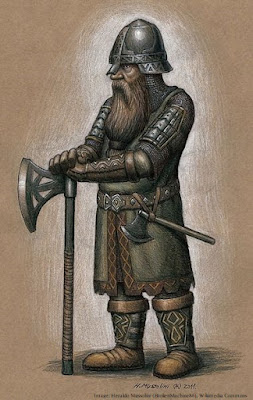
Dwarves
Special: Dwarves begin play with the following modifiers.
     * +1d2 Strength, Wisdom, & Constitution, along with -1d2 Dexterity & -1d4 Charisma.
     * +2d4 bonus to crafting and engineering-related checks, being naturally akin to made things.
     * Are short and stocky, often bearded (at least for males), and move more slowly, taking a -10' penalty to their speed, though they also ignore any movement penalties from wearing heavy armor and/or when spelunking.
     * Advance in level at a rate 10% slower than humans, being fairly stubborn and unwilling to change.
     * Naturally hate orcs and goblinoids, and must save vs. spell/ make a Will save DC 15 to refrain from attacking them on sight, even if inopportune. Black dwarves may instead tolerate such humanoids as useful underlings.
     * They also generally dislike elves too.

Associated Divinities & CultsVulcan, Ilmarinen, Dagda, Svarog, Thor, Loki, Dis PaterUncle Steel Dwarf
     
And as a racial class, they have the following rules.
HD: d6+2
Attack Bonus: +1 per 2 levels, rounded down
Saving Throws: Fortitude & Will-type: +1 bonus per level. Reflex-type: +1 bonus per 3 levels.
Allowed Weapons: Axe, hammer, mace, dagger, & 1 more of their choice
Allowed Armor: Any
Special Abilities: Dwarves gain unique abilities as they advance in level. Each one also has a requirement too.
* They gain two special abilities at 1st level: one selected at random and the other picked. 
* They can then pick an additional special ability at every level thereafter

While all of the abilities are listed under a particular dwarf type, with the Referee's permission they may be selected from other dwarf types too (keeping in mind that dwarves are very traditional and usually stick to one list). In any case, each ability can be selected more than once, allowing the bonuses to compound each other. For example, selecting Dwarf Fighter twice would grant double the listed benefits. 

Hill Dwarves
Dwarf Lord: gain a +1 attack bonus with one of their allowed weapons, though their experience penalty becomes 25% (instead of just 10%) because of their increased stubbornness. One of their weapons, shields, or suits of armor also gains a permanent dwarf rune on it, granting either a +1 bonus to attack, damage, to AC, or even a +3 bonus to saves.
Dwarf Cleric: gain the spellcasting abilities of a 1st level cleric, but will insist on only following strict dwarven traditions at all times. See also Part III for magical side-effects.
Dwarf Fighter: gain a +1 
bonus to attack, +2 hit points, and a +1 AC bonus. Add 1 other weapon type to their allowed list too, but they usually are hostile to any elves or similar types that they first meet.
Dwarf Smith: can craft items worth 1d6+3 gold pieces for every day of work they do, but suffer a divine test from a smith god (such as Vulcan- see Volume II) once for every 12 items completed. 

Read the full article here.


Next week: Dwarves, Part II!

Wednesday, February 2, 2022

Elves, Part V

 
Elven Divinities & Cults
Elves often see their divinities more collegially than humans do. For example, elves may maintain that (select or roll 1d6): 
1. Their divinities are near equals, just very powerful elves, though still worthy of admiration. 
2.
Elves are part of their divinity's entourage, and truly set apart from other mortal folk.
3.
Their deities frequently bless them- they are their favored people.
4.
Though elves are the chosen people, their divinities have been absent of late.
5.
Their gods might be distinct, but elves are quite skilled in earning their favor.
6.
Elves pray to gods much like humans do. It is no matter.

Whatever their view, such an outlook is reflected in the elven use of distinct magical side-effect tables (detailed in Parts III & IV) rather than the standard ones used for their deities. And, in addition to determining which divine tests and spells they may have access to, elves also associate the various special abilities they receive as gifts from their gods. The listed abilities are noted for high elves first, then grey elves, wood elves, wild elves, and finally, dark elves. Humans can emulate elven abilities with the spell Assume Elvish Quality (detailed below), harnessing some elven power that matches their cult for a time

Unique elven perspectives on a number of their deities follow, accompanied by the names the elves are known by. These beliefs can be substituted for or used in addition to one or more of a god's or goddess's usual tenets.

Freyr
The prosperous wonder of the alfar and Alfheim benefits many. Most who follow him are high elves, while a good number are gray elves, espousing high adventure and the plenty that can come with it.
Usual Abilities (roll 1d10): [1] elf lord, [2] hyperborean, [3] elvish music, [4] elvish weapon, [5] elvish items, [6] faerie blood, [7] hidden in the wood, [9] reroll twice, [10] other elf ability

Freya
Beauteous magic and the warring craft of the alfar and huldrafolk yield undying interest. Mainly high elves, she counts a sizeable number of gray and wood elves amongst her faithful too: beautiful, loving, and free.
Usual abilities (roll 1d12): [1] hyperborean, [2] divine blood, [3] elf warrior, [4] elf seer, [5] elf mage, [6] elf mystic, [7] 
elf nymph, [8] unearthly beauty, [9] nature friend, [10] spirit elf, [11] reroll twice, [12] other elf ability

Lugh 
The many talents of the sidhe is expressed in greatness. Most are gray elves, though some high elves call him patron as well, all striving for superior craftmanship in all things.
Usual abilities (roll 1d12 twice, gain both abilities, but each only work 75% of the time they're attempted): [1] elf lord, [2] elf warrior, [3] elvish music, [3] high-born, [4] elf knight, [5] elf mage, [6] elf rogue, [7] elvish mariner, [8] elf rogue, [9] elvish item, [10] elf druid, [11] elf ranger, [12] reroll twice again

Danu
With the enduring hold of the earth, the sidhe can last an eternity. Many of her tribe are gray elves, though plentiful wood elves honor her too, perpetuating a naturalistic, fey land.
Usual abilities (roll 1d10): [1] elvish items, [2] faerie blood, [3] elf mystic, [4] elvish acrobat, [5] unearthly beauty. [6] spirit elf, [7] elf druid, [8] nature friend, [9] reroll twice, [10] other elf ability

Artemis
The dryopes' secrecy and amazing woodcraft are forever sacrosanct. Naturally that includes mostly wood elves, but a certain amount of wild elves are ubiquitous as well, protecting their lands from those uninvited.
Usual abilities (roll 1d12): [1] elf druid, [2] elf ranger, [3] hidden in the wood, [4] nature friend, [5] natural archer, [6] oak totem, [7] wandering feast, [8] atavistic, [9] elf hunter, [10] stag totem, [11] way of Selene, [12] reroll twice

Apollo
Hyperborean light, music, and might shines forth. What would be more fitting than high elves, with a lesser number of gray elves, refining that brightness too?
Usual abilities (roll 1d12): [1] elf lord, [2] high born, [3-5] hyperborean, [6] divine blood, [7] elf seer, [8] elvish music, [9] elvish weapon, [10] elvish items, [11] reroll twice, [12] other elf ability 

If you like my work, consider joining my Patreon and read the full article here.
------------------------------------------------------------------


Assume Elvish Quality (3rd Level Cleric Spell)
Casting Time: 1 round
Range: touch
Duration: 1d3 turns
Effect: Gain or grant a randomly determined elvish ability that is associated with the divinity you follow. For example, a follower of Artemis could gain one of the elven abilities on her list above for the spell's duration.


Next week: we continue our series on folk with Dwarves!


Wednesday, January 26, 2022

Elves, Part IV

Requirements by Elf Spellcaster Type
Yet more ways for how elven spellcasters can make their magic work.

Elf Mage (d10)
1. Wear ceremonial or magical garb.
2. Hold a magic wand or staff.
3. T
he stars, sun, and/or moon are aligned in a certain way that reflects the spell.
4. The current phase of the moon or tidal flow reflects the spell.
5. Use a substance that reflects the spell.
6. Hold an item that's meant to power the spell.
7. Sing or play a song of Magic 
for at least 3d4 rounds, either before or after the spell is cast.
8. Have reviewed the spell in written form at some point prior that day.
9. Gesture and chant loudly for 1d2 rounds before casting the spell.
10. Reroll twice and follow both requirements.


Elf Druid 
(d8)
1. Be barefoot.
2. Be in a natural area.
3. The current season or time of day reflects the spell.
4. The current phase of the moon or tidal flow reflects the spell.
5. Be near a plant or animal that can convey the spell.
6. Use a specially harvested herb.
7. Sing or play a song to Nature for at least 3d4 rounds, either before or after the spell is cast.
8. Reroll twice and follow both requirements.

Elf Shaman (d8)
1. Wear totemic garb or carry a fetish.
2. Chant or drum for at least 1d3 rounds before casting the spell.
3. Leave fitting spirit offerings.
4. Dance for at least 2d3 rounds after casting the spell.
5. Experience visions after casting the spell, being unable to act 
effectively for 3d4 rounds. 
6. Take a hallucinatory substance, causing a -1d6 to all rolls for the next 1d6 turns after casting the spell.
7. Sing or play a song to the Spirits for at least 3d4 rounds, either before or after the spell is cast.
8. Reroll twice and follow both requirements.


If you like my work, consider joining my Patreon and receive bonus content here.


Next week: Elves, Part V!


Wednesday, January 19, 2022

Elves, Part III

Elven Magical Side-Effects
Being well known for their enchanted nature, elves often experience beneficial results when working their spells. Such is the congenial relationship with their gods and other powers that they experience unique magical side-effects. 

When an elf casts a spell, first roll 1d12 on the table below for the general side-effect. Then, if a requirement is called for, roll on the table for the elf's spellcaster type to determine what each specific requirement is. 

1. Requisite Abiding: The spell must submit to the requirement. If it's not fulfilled, then the magic will be undone.

2-3. Requisite Twixt: The elf need follow at least one of two requirements for the spell, otherwise it will only work at 50% of its usual strength.

4-6. Aura Elder: An area radiating 1d20 x 5' from the spell's casting causes all who follow the same ethos as the elf to gain a +1d4 to all rolls while within. If not, then they suffer the same in penalty. The area remains so charged for the next 1d20 rounds.

7-8. Requisite Salutary: If the elf follows the requirement, then the spell's effect, range, or duration can be improved by 50%. If not, then the spell just works normally.

9-10. Requisite Propitious: The elf need follow at least one of two requirements so that the spell's effect, range, or duration can be improved by 100%. If not, then one of its aspects can still be boosted by 50%.

11-12. Elven High Magic: The elf may automatically double the spell's range, effect, or duration. Alternatively, he or she may opt to follow a randomly determined requirement and thereby be able to triple one of those aspects, as well as select the requirements they'll have when casting their next three spells too.


Requirements by Elf Spellcaster Type
Different types of elven spellcasters naturally have different requirements for making their spells work. When a requirement is called for, roll on the corresponding table below.

Elf Lord (d6)
1. Point their weapon at the spell's target.
2. Gesture or chant loudly.
3. Be in a natural or otherwise beautiful area.
4. The spells results occur in a way that would seem a coincidence.
5. Cast the spell to bring about more harmony and balance in some way.
6. Cast the spell in a way to demonstrate the superior ways of elves.

For example, when an elf lord character casts a spell, his player rolls a 2 on the d12 (Requisite Twixt). He then rolls twice on the Elf Lord requirement table and gets a 3 and a 5. He therefore must either gesture or chant loudly, or cast the spell to bring about more harmony and balance in some way. If not, then the spell will only work at half its usual strength.


Bonus Content found on Patreon


Next week: Elves, Part IV!

Wednesday, January 12, 2022

Elves, Part II

 
Additional Elf Abilities
Gray elves, wood elves, wild elves, and dark elves have different special ability considerations than high elves. Though each one comes with a disadvantage, elves can attempt to resist it by saving vs. spell/ making a Will save DC 15. If successful, they can act as they wish in that situation, but will have to save again to resist acting that way when another such situation arises. For example, an elf rogue can save to resist being secretive even when not using his abilities, but must do so again to not be unnecessarily secretive in the future.

Gray Elves
1. Elf Mage: can cast spells as a 1st level magic-user, but can't wear armor or use shields. They must also cast at least 1d3 spells per day. See also Part IV for magical side-effects.
2. Elf Rogue: can use the abilities of a 1st level thief, but must be secretive even when not using them.
3. Elvish Items: pick one item they possess. It now confers either a permanent +4 bonus to hiding, a +4 bonus to moving silently, lasts 4 times longer (if expendable), or weighs 50% less. If destroyed, the elf may use this ability once again to create a new elvish item, limiting the number that can be in existence at one time. If stolen, the elf will become obsessed with recovering it.
4. Elvish Mariner: gain a +2d3 bonus whenever making checks involving swimming, sailing, or when simply being around a large body of water. Will suffer a set -2d3 penalty to all rolls each day that they don't see the sea or some other large body of water though.
5. Elf Nymph: If female, gain general nymph traits, plus one nymph ability for every time this ability is selected (link). Are subject to a nymph's disposition though. 

Wood Elves
1. Elf Druidgain the magical abilities of a 1st level druid, but will only eat natural food (preferably prepared by elves). See also Part IV for magical side-effects.
2. Elf Ranger: gain a +1 bonus to all rolls made vs. orcs and goblinoids. Also gain a +2 bonus to any rolls made when in a terrain type of their choice (typically forests), but must be hostile to any who fail to give such places the utmost respect.
3. Hidden in the Wood: gain a +2d4 bonus when attempting to conceal themselves and move silently in sylvan settings, +1d4 when in other natural places too. Can also move through woodland terrain with 50% less impediment and chance of negative encounter., but also suffer a -2d4 penalty to all rolls when in populated areas.
4. Nature Friend: can speak with and gain a +2d4 bonus to befriend either animals, sentient plants, or other nature beings (pick an additional one each time this ability is selected). Also suffer a -1d10 to reaction rolls when dealing with civilized types, especially humans.

Wild Elves
1. Atavistic: gain one satyr aspect (horns, goat legs, or horse legs), but also the race's disposition at 1/2 the intensity (link).
2. Elf Hunter: gain a +1d3 bonus to hit and damage when first attacking an unaware foe, in addition to any other bonuses. Also gain a +2d4 bonus to rolls made to surprise or to evade ambush, but will not trust outsiders.
3. Elf Savage: can use a 1st level barbarian ability of their choice, see Totems for suggestions (link). Also lose 1d3 Intelligence though.
4. Elf Shaman: gain the spellcasting abilities of a 1st level shaman, but can't wear armor or use shields. They must also destroy any mechanical things they find. See Totems for suggestions and Part IV for magical side-effects.

Dark Elves
1. Black Elf: can cause a target within sight to save vs. death/ make a Will save DC 10 or gain a random illness, typically causing 1d3 Constitution loss per day until cured. Usable 3 times per day, but they must let the victim know who did it!
2. Dark Sight: can see in the dark, but suffer a -1d3 penalty to all rolls when in brightly lit areas.
3. Elf Reaver: gain a +1 attack and damage bonus with one of their melee weapons of their choice, but will even betray allies at the earliest opportunity.
4. Elf Witch: can cast spells as a 1st level magic-user, but can't wear armor or use shields. They must also roll on the Elf Witch requirement table- see Part IV. Also prone to spontaneous cackling and cruelty, making their presence obvious.

Half-Elves
Treat as a human character except that they gain one randomly determined elf ability. In return, they take a 10% experience penalty.


Bonus content: Patreon


Next week: Elves, Part III!

Wednesday, January 5, 2022

Elves, Part I

We begin a new series exploring various mythical folk and how they relate to divinities and cults. 

Elves

Special: Elves begin play with the following modifiers.
     * +1d2 Dexterity, Intelligence, Wisdom, & Charisma, along with -1d2 Strength & Constitution.
     * +2d4 bonus to sight- and hearing-related checks, being naturally good at noticing things.
     * Are quite long-lived and don't suffer from decrepitude.
     * Advance in level at a rate 25% slower than humans, being quite otherworldly and haughty.
     * Naturally hate orcs and goblinoids, and must save vs. death/ make a Will save DC 10 to refrain from attacking them on sight, even if inopportune. Dark elves may instead tolerate such humanoids as useful fodder.
     * They also generally dislike dwarves too.

Associated Divinities & Cults
     High Elves - Freyr, Freya, Lugh, Danu, Brigid, Artemis, Apollo, Mercury, Venus, Ilmatar, Dazbog, Lada
     Grey Elves - select from any of the Elf lists.
     Wood Elves - select from the High and Wild Elf lists, along with Tree Totem.
     Wild Elves - Cernunnos, Epona, Pan, Mielikki, Veles, Enki, Totem Animal
     Dark Elves - Hel, Arianrhod, Trivia, Hecate, Ariadne, Louhi, Baba Yaga, Maelfo, Dark Animal Totem (spider or bat)

And as a racial class, they have the following rules.
HD: d6
Attack Bonus: +1 per 2 levels, rounded down (0, +1, +1, +2, +2, etc.)
Saving Throws: +1 bonus per level to all
Allowed Weapons: Bow, sword, spear, dagger, & 1 more of their choice
Allowed Armor: Chainmail and shield or lighter
Special Abilities: Elves gain unique abilities as they advance in level. Each ability also gives a disadvantage too.
* They gain two abilities at 1st level: one selected at random and the other picked. 
* They can then pick an additional ability at every level thereafter
Each is listed under a particular elf type, but can be selected from different types with the Referee's permission, especially if wishing to create other types of elves (e.g. green elves, sea elves. polar elves, etc.) Each ability can also be selected more than once, allowing the bonuses to compound each other. For example, selecting Elf Mage twice would allow the elf to cast spells as a 2nd level magic-user. 

High Elf Abilities
Elf Lord: gain an additional +1 attack bonus with one of their allowed weapons of their choice. Can also cast a 1st level magic-user spell of their choice as a magic-user of equal level, though their experience penalty becomes 33% (instead of just 25%) because of their increased haughtiness. See Part III for magical side-effects.

Elf Warrior
: gain a
n additional +1 bonus to attack and a +2 AC bonus vs. foes they're aware of. Add 2 more weapon types to their allowed list too, but must save vs. death/ make a Will save DC 10 or become hostile to any dwarves they first meet.

High-Born
: gain +1d2 Intelligence and +1d2 Charisma, but also a -3d4 penalty to social rolls when dealing with low-born types, including most dwarves. 

Hyperborean
: gain +1d6" in height and immunity to harmful light, cold, or psychic effects (pick an additional one each time this ability is selected), but also a -2 to all rolls when in intense darkness, heat, or when within 30' of dullards (humans, dwarves, or humanoids with an Intelligence of 6 or less). 

Bonus content: Patreon 


Next week: Elves, Part II!


Wednesday, December 29, 2021

Totems, Horse: Part V


Horse Divinities & Folk Variations
Characters can select various horse totem abilities, spells, side-effects, and totem tests to replace ones they would normally have, reflecting how the horse can bring one to new places. Select or roll 1d6.

1. Greek & Centaurs: Followers of Zeus can espouse Pegasus, mixing the swiftness of the steed with the flying ability of the eagle to assist with thunderbolt use and vanquishing monsters. Poseidon's acolytes may instead espouse Hippocampus which combines piscine water-abilities, Arion which emphasizes virility and battle. Other Greek divinities & titans are followed by centaurs, who can make for iconic horse barbarians and shamans (link).

2. RomanMars's devotees often enjoy harnessing the horse via Equus October, and thereby focus on its more martial and sacrificial aspects. Charioteering is emphasized too, see #6 below for details.

3. Celtic: Detailed here (link), as horse goddess, Epona represents a tie to the land. The totem can be used to emphasize that and to add a variety of choices for her faithful as well.

4. Anglo-Saxon: Until they can be described in more detail, Hengist and Horsa (stallion and horse) can be represented fully by the totem as divinities. Instead of shamans, they are served by clerics who use the Anglo-Saxon magical side-effect table 50% of the time instead (link). Similarly all random results become averaged. For example a +1d3 modifier becomes a +2, because the magic of divinities is more steady than that of totems.

4. NorseOdin's faithful can emphasize the horse's travel quality, even unto other realms, via Sleipnir. Such power can take on more abstractions with the Raidho (riding) and Ehwaz (horse) runes, granting might via transition and union respectively. The latter can become quite prevalent amongst the cult of Freyr especially.

5. Slavic: The horse's free movement can be emphasized in the followers of Jarilo. Dazbog's devotees too can harness the horse, though via his chariot, and is more swift and martial in nature. All would benefit upon the open plain.
 
6. Sintashta & Chariots: Following along the trend of chariots, the Indo-European Sintashta culture is perhaps the first to use horses to protect their lands and defeat their foes in such a manner. They, and others like them, can use many of the totems benefits, especially ones that aid in conquest. And with the chariot aspect, they can grant another who is next to them the same benefits at the same time, though with double the chance of a divine test. It is a powerful but dangerous endeavor indeed.


Next week: we move on from Totems for now and begin a new series on Folk, starting with Elves!

I now have a Patreon and SubscribeStar available. Those who join will get access to my articles sooner and in their entirety. Even better, you'll be supporting my work. The links are here


Wednesday, December 22, 2021

Totems: Horse, Part IV

Those swift shamans and cleric-types who call upon the spirit of the horse will gain access to certain spells, abiding by totemic magic guidelines (link) along the way. 

HORSE SHAMANISM
1st Level Spells (d7)
1. Equine Protection: as Protection from Evil, but only works in open and grazing areas.
2. Free Prancing: as Sanctuary, but the recipient must run for it to work.
3. 
Horse Companion: as Animal Companion (D), but must be a single horse.
4. Horse Sense: as Detect Snares & Pits (D), but only works outdoors.
5. Outrun Light Wounds
: as Cure Light Wounds, but the recipient must move at a speed of at least 1d6 x 10' for 1 round.
6. Wholesome Stable: as Purify Food & Drink, but must be cast in a pasture, stable, or other place where horses are usually present.
7. Willing Mount: as Remove Fear, but calms a horse at up to 1d4 x 10' away, so that it doesn't panic and can even be mounted if it's not already mounted or attacking the caster.

2nd Level Spells (d7)
1. Centaur's Call: as Charm Person or Mammal (D), but wine or other strong spirits must be available.
2. Draft 
Horse: as Strength*, but only gains 1/2 the strength bonus, and 1/2 the bonus is also applied to the recipient's Constitution too.
3. Equine Blessingas Bless, but grants a +1d2 x 5' speed and a +1d2 AC bonus to allies instead.
4. Greater Willing Mount: 
as Remove Fear, but calms an equine being 
at up to 1d4 x 10' away, so that it doesn't panic and can even be mounted if it's not already mounted or attacking the caster.
5. Horse Spirit: as Unseen Servant, but cannot open things, although it can carry triple the usual amount and is quite swift.
6. Horse Tell: as Augury, but requires watching a horses actions.
7. Speak with Horsesas Speak with Animals, but only works with horse-kind.

3rd Level Spells (d7)
1. Equine Protection 10' Radius: as Protection from Evil 10' Radius, but only works in open and grazing areas.
2. Fleet Horse: as Haste, but only affects 1 target and only grants a speed bonus,
3. Greater Draft Horseas Draft Horse (above), but grants a +2 bonus to each along with no limit of 18.
4. Horse Cure
: as Cure Disease, but makes the recipient naggy and skittish for the next 1d6 turns too. 
5. Horseskin Magic: as Polymorph Self or Other*, but can only take on or grant the form of a horse or other equine creature.
6. Throw Rider
: as Remove Fear (reversed), but can be used at up to 1d4 x 30' away, causing a mount to immediately attempt to throw off its rider. The latter can save vs. paralysis/ make a Reflex save DC 15 to stay on.
7. Warhorse
: as Striking, but only works on hooves and the weapons of mounted individuals.

4th Level Spells (d6)
1. Fleet Herd: as Haste, but only grants a speed bonus.
2. Horse Call: as Summon Animal I (D), but just summons horses. 
3. Horse's Exorcism: as Exorcism, but only works on non-equine type spirits.
4. Outrun Serious Wounds: as Cure Serious Woundsbut the recipient must move at a speed of at least 1d6 x 10' for 1d2 rounds.
5. Pasture-Fed: as Create Food and Water, but only in a pasture or other open, natural setting.
6. Stalwart Unicorn: as Dispel Evil, but the totemist must charge the targets.

5th Level Spells (d5)
1. Greater Horse Call: as Summon Monster*, but either summons a pegasus, unicorn, or nightmare, with 3 rounds less duration in the third case.
2. Greater Horseskin Magic: as Polymorph Self or Other*, but can just take on or grant the form of a pegasus, unicorn, or nightmare, with 3 rounds less duration in the third case.
3. Horse Communion: as Commune with Nature (D), but only works in areas where horses inhabit.
4. Outrun Critical Wounds: as Cure Critical Woundsbut the recipient must move at a speed of at least 1d6 x 10' for 2 rounds.
5. Soaring Pegasus: as Fly*, but the caster must be mounted or already in horse form first. 

6th Level Spells (d3)
1. Horse Trail: as Find the Path, but the caster must be mounted or already in horse form first.
2. Master Edward's Conversations: as Speak with Creatures, but requires a horse head being present, whether attached to a living one, the shaman has one already.
3. Sleipnir's Ride: as Plane Shift, but those venturing must be mounted or already in horse form first.

Next week: Totems: Horse, Part V! 

Also, note that I now have a Patreon and SubscribeStar available. Those who join will get access to my articles sooner and in their entirety. Even better, you'll be supporting my work. The links are here